CreateSpace for minors?

My daughter is interested in self-publishing her own book. I’ve been checking out CreateSpace and am not sure if it is available to minors. Do you know?


CreateSpace (a division of Amazon) offers a great service to get self-published books in print! Good for your daughter.

Unfortunately, CreateSpace does put up some roadblocks for teenagers.

Here’s the experience of one dad:

https://www.createspace.com/en/community/message/69077

CreateSpace allowed his teenage son to write a book, but required that royalty payments to go to the father’s name. Dad didn’t like this because it made his taxes go up.


The problem is that CreateSpace doesn’t want to enter into an agreement (i.e. the royalty agreement) with minors.

Why not?

The laws of  most states set the age for entering into a legally binding contract at 18.  It’s not illegal to enter into a contract with a minor — just ill-advised, because a  minor can avoid obligations created under the contract (i.e., back out of it) until he/she reaches majority age.


So, help your daughter out and encourage her to self-publish her book. Here’s how you can deal with the royalty payments:

How to deal with royalty payments to a parent, not the teenager


Hope that helps.  Good luck!


Carol Topp, CPA

How to deal with royalty payments to a parent, instead of the teenager

U.S. Tax Forms © by MoneyBlogNewz

In CreateSpace for minors? I discussed that CreateSpace (a division of Amazon that prints self-published books, CDs and DVDs), will not make royalty payment to minors (teenagers under age 18).


Instead CreateSpace will pay a parent, but not the teenager.


Here’s how to handle the situation:

1. A parent (say dad) agrees to accept the royalty payments in his name (even though his daughter wrote the book, her name is on it, and she deserves the cash from royalties!)

When dad gets a royalty check from CreateSpace, he gives the cash to his daughter.

2. Dad may get a tax form (1099MISC) at the end of the year showing how much CreateSpace paid him in royalties from his daughter’s book. If he doesn’t get the tax form from CreateSpace, he should still do step 3.

3. Dad MUST include this information on his tax return on Schedule C Profit or Loss from Business (even though he doesn’t technically have a business).

4. Dad should then include all the money he gave to his daughter on his tax return as a business expense. Put it on line 27 Other Expenses on the Schedule C with the explanation on page 2 of the form “Income assigned to Daughter’s name.”  This is to explain to the IRS that dad accepted the money (income) on behalf of his daughter, but it’s really hers (assigned to her).

If he does it correctly, the bottom line on dad’s Schedule C will show a big , fat zero. There will be no profit from his business and no additional tax to pay. It all transferred to his daughter.

5. Daughter must also fill in a Schedule C on her own tax return. I cover that in my book, Money and Taxes ins Micro Business.

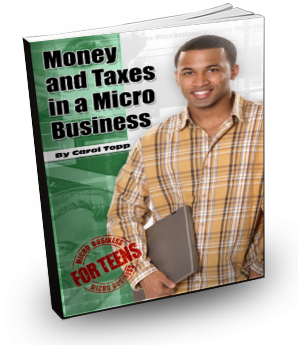
Money and Taxes in a Micro Business

Price $9.95

Read  the Money and Taxes Table of Contents

View Money and Taxes Sample Pages


Carol Topp, CPA

Teaching your kids about money and business

Interview with Hannah Keely on

Teaching Your Kids About Managing Money (when you’re not doing so great yourself).
And how to help your kids start a micro business.


How to Teach Kids About Managing Money (When You’re Not Doing So Great Yourself)

So you don’t consider yourself a financial role model. Take heart, you can still teach your kids financial principles. This interview offers tips on how to teach your kids the money basics as part of your busy lifestyle. We’ll also discuss what topics to teach at each age from preschoolers to college age.

Listen to internet radio with Hannah Keeley on Blog Talk Radio


Here’s a helpful handout: How to Teach Kids About Managing Money


Carol Topp, CPA

How to Teach Your Kids About Money radio interview


I’m being interviewed on The Sociable Homeschooler today (Friday July 22, 2011) at 9 am EST on teaching our kids about money and starting a micro business.


Listen in at http://toginet.com/shows/theso?ciablehomeschooler


Handout for How to Teach Your Kids About Money


Hope you enjoy the show!


Carol Topp, CPA

How to Raise an Entrepreneur

The Wall Street Journal recently ran an article titled “How to Raise an Entrepreneur.”

One commenter, who owns his own engineering firm, asked:

Nice, but how do you prepare them for the IRS paper, 941′s and 940′s, (withholding and federal unemployment), w-2s and w-3s, (employee reporting and employer reporting for SS and Medi)? Don’t forget the 1120′s (corporate tax filing).

Duplicate ALL of this at the state level and add Business Entity Taxes, Sales and Use tax filing,and filing the annual report with fee. If your S corp is in two states duplicate this for the foreign filings (out of state). Add the agent for the foreign S corp.

Then we get to the insurances. Property and liability, workers comp and if there is any money left, health insurance. and the list goes on, all for a 1-5 person S Corp.

Guess that there was a point in this list and that would be to give our kids a business environment that is conducive to conducting business.

Scott P. (used with permission)


Scott is correct there can be alot of paperwork, IRS forms and state laws for a micro businesses owner to understand.

But it’s not impossible.

My reply to Scott:

How do you prepare them? A little at a time.

I recommend that a teenager start a micro businesses as a sole proprietorship (not a corporation or partnership) with no employees (so no 941s, w-2, etc.) . I also recommend service businesses, not product sales, to (usually) avoid sales tax. If they do want to sell a product, they will learn a lot and apply math skills to calculating the sales tax. It’ll be good for them.

Finally, I recommend they create home-based businesses and I find they can usually get an insurance rider on their parents’ homeowner policy, if needed at all.

If students learn basic business skills as a teenager, they won’t be as overwhelmed when starting a small business as an adult.

I agree with your final comment and I do hope some of these teenagers grow up and try to change the business environment. I’d like to see more small business owners run for public office or influence legislation.


Carol Topp, CPA
Author Micro Business for Teens

If you sell a product, be ready for sales tax!

I usually encourage teenage micro business owners to start a service business instead of selling a product, because service businesses are easier to start and manage.

But sometimes a teenager has a great idea of a product to sell. I don’t want to discourage a teenage entrepreneur, but selling products involves knowing about sales tax.

Here’s what you need to do about sales tax (from my book Money and Taxes in a Micro Business):

1. Read up on your state’s sales tax laws.

Most states have a website that explains their sales tax rules. Most states only tax retail sales. Retail sales are the sale to the final customer. Wholesale sales are usually not subject to sales tax. Wholesale sales are usually large quantity sales sold to someone other than the final consumer such as to a business or manufacturer.

This website will help you determine what your state and local laws are concerning sales tax: www.taxadmin.org/fta/link/

2. Obtain a vendor’s license

Most states require businesses to apply for a vendor’s license if they make sales-taxable transactions. Sometimes the state calls it a business tax registration or a sales tax permit. This website www.taxadmin.org/fta/link/ will lead you to the registration information for your state.

Sometimes a state’s sales tax laws can be difficult to understand, so do not be afraid to call your state’s sales tax office. Rehearse what you will ask before calling and say something like, “I’m starting a new business selling ________. Will I need to collect sales tax?” Then ask for information to be mailed (or e-mailed) to you. Do not hang up without getting confirmation that something will be sent to you.

3. Pay your sales tax

For most micro businesses, sales tax will need to be paid only annually or quarterly, but that can vary depending on your state law and the amount of sales you make. Very large retailers must pay sales tax monthly. For example, in New York State, you file a sales tax return only once a year if you owe $3,000 or less in sales tax during the year. The form and tax payment are due March 30.

Mark your calendar with the sales tax due date for your state and send it in on-time or early. If you are late, you will probably be charged a fine.


You can read more about sales tax in my book Money and Taxes in a Micro Business including: 

  • What you need to know about vendor’s licenses
  • Out of state sales
  • Internet sales
  • How to calculate sales tax

Read more about the book including the Table of Contents and a sample here.

Etsy and Sales Tax

Hi Carol,
My 13yo daughter just opened an Etsy shop to sell model horse tack. (Is that considered a micro business?)
I am going to order your micro business curriculum (Starting/Running/Workbook). Is tax info covered in the curriculum?

Good for your daughter and, yes, her Etsy store is a micro business! :-)

You would probably benefit from the Money and Taxes in a Micro Business book because it discusses sales tax as well as income and self-employment tax.  The Money and Taxes in a Micro Business is not part of the 3 book curriculum you mentioned. It’s the 4th book. Read more about Money and Taxes in a Micro Business here.

I read up on how Etsy handles sales tax. If you program in your state into your Etsy store, Etsy will add the sales tax to customers from that state. You do not have to collect sales tax from out of state customers. Here’s a helpful explanation from Etsy:
http://www.etsy.com/storque/seller-handbook/tax-tips-everything-you-need-to-know-about-sales-tax-10963/

Fortunately, Etsy’s new Checkout process gives sellers a one-time, simple way to calculate and set up their sales tax collection down to the zip code. Just go to Sales Tax under Your Etsy and enter the rates for each U.S. state or zip code, Canadian province, or country where you would like to charge sales tax. When a shopper from that area buys from you, sales tax will automatically be charged. Find step-by-step instructions on setting up your Etsy sales tax collection in the Help section.

Your daughter will  have to add up the sales tax each quarter (or half year) and send in the sales tax collected to her state. From Etsy’s website:

It is your responsibility as an Etsy shop owner to report and remit the sales tax you’ve collected to the appropriate taxing authority. And every state collects in a different way. For instance, in California, state sales taxes are collected by the State Board of Equalization, which also issues mandatory sellers permits (required for sellers who sell tangible goods, such as Etsy sellers). To find out who administers sales tax in your state — and what you need to do to stay legal – find your state guide at Outright.

Sales tax can get complicated, but Etsy makes it pretty easy. Your daughter will learn a lot about taxes, setting her price, dealing with her state sales tax division and being responsible for sending in her sales tax payments! You’ll be very proud of her!

Teens and Taxes ebook on sale until 1/31/2011

If you started a micro business in 2010, you are going to have some extra tax issues in 2011.

I have a website, TeensandTaxes.com to help teenage business owners understand when and if they owe any taxes on their business income.

Taxes can be confusing, so grab a copy of my ebook, Teens and Taxes: A Guide for Parents and Teenagers.  It will clear the confusion for you.

The ebook is on sale for $8.95 (regularly $14.95) until January 31, 2011.

The is a 42-page ebook with chapters on

  • employees
  • independent contractors
  • household employees
  • kiddie tax on investment income
  • business income

Read more about the ebook here

Read a sample chapter here

View the Table of Contents here

Available for immediate download. $14.95 $8.95 on sale until January 31, 2011

BlueBuyNow

Tax Jujitsu. Would it help business owners?

Robert Reich

Robert Reich, who is now a professor at UC Berkeley used to be Secretary of Labor under President Clinton, has an idea he calls Tax Jujitsu or the Peoples Tax Cut.

Jujitsu: a method developed in Japan of defending oneself without the use of weapons by using the strength and weight of an adversary to disable him.
Here’s the idea:
Democrats should propose eliminating payroll taxes on the first $20,000 of income, and making up the revenue loss by applying payroll taxes to incomes above $250,000. Read all about it here:
I actually like some things about this idea, but here’s my question:

Would that apply to teenagers who own a micro business? In other words, would business owners benefit too, or only people working for an employer?

Business owners (including teenagers) have to pay 15.3% of their profits to Social Security and Medicare (it’s called self-employment tax. Read more about it at TeensAndTaxes.com).

Wouldn’t it be great if a teenager could start a micro business and know it would be self-employment-tax free up to $20,000!

Wow! Now, THAT would stimulate the economy! We’d find kids starting businesses like crazy. Maybe their parents would start a business too! Maybe these businesses would grow and hire employees, putting more people to work.

Or better yet, maybe these businesses would hire owners of other people who own their own business like webmasters, freelancers and independent contractors. This would spread like wildfire and really get the economy back to health!

I can dream can’t I?

If you make money at writing

I’m doing a workshop for my local writers group titled

The Business of Writing: What to Do if You Ever Make Money with Your Writing.

I’ll be discussing the difference between writing as a hobby, as a ministry to help others or as a business. I’ll also talk about taxes, special deductions for authors and what business structure a writer should have for  a writing business.

Here’s a handout that I prepared for the workshop.

The Business Of Writing

If you live in the Cincinnati area, come attend the workshop live!

Wednesday, June 23 at 7:00 p.m. at Faith Church in Milford